Market fluctuations: what do they mean for your investments?

June 2026
The past few years have seen significant market volatility driven by geo-political events and international conflict. While at times these can be concerning, market volatility is part of investing. By understanding how to navigate these circumstances, long-term financial goals can remain on track.
Understanding Market Volatility and Its Impact on Investments
It can be unsettling to witness the effects of market volatility on your investments, especially in light of ongoing foreign conflicts. You may be wondering what steps to take next. Firstly, it's crucial to consider market performance over the long term, as this reveals how markets have historically responded to various economic and event-driven changes.
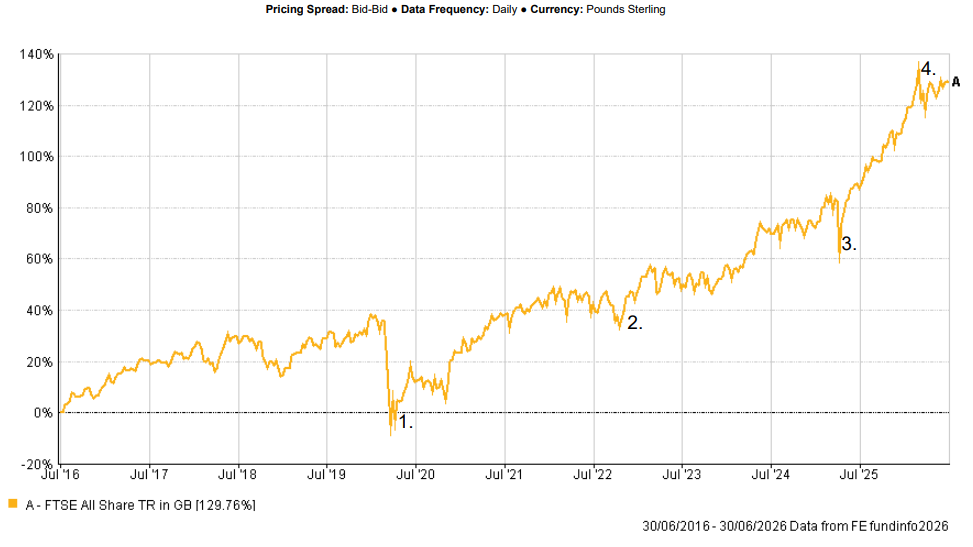
Over the years, there have been numerous market shocks. The accompanying graph highlights several notable events, illustrating their impact on the FTSE All-Share index (which tracks the UK stock market) and the duration it took for markets to recover.
Please remember that past performance is not a reliable indicator of future results. The value of investments and the level of income received from them can fall as well as rise and is not guaranteed. You may not get back the amount of your original investment.
| 30/06/2025 to 30/06/2026 | 30/06/2024 to 30/06/2025 | 30/06/2023 to 30/06/2024 | 30/06/2022 to 30/06/2023 | 30/06/2021 to 30/06/2022 | |
| FTSE All Share TR in GB | 21.9 | 11.2 | 13.0 | 7.9 | 1.6 |
- Mar 2020 – Covid 19 Pandemic: Lockdowns, travel restrictions, and economic disruptions resulted in extended, widespread market uncertainty.
- Mar 2022 – Invasion of Ukraine / Inflation & Interest Rate Hikes: Russia sent troops across the border to invade Ukraine. Central banks such as the Bank of England implemented aggressive interest rate hikes to curb inflation.
- Apr 2025 - Trump Tariffs: Sweeping trade tariffs were applied on most global imports to the US and additional reciprocal tariffs ranging from 11% to 50% on over fifty countries.
- Mar 2026 - Iran Conflict Escalation: Rising geopolitical tensions lead to armed conflict in the Middle East, raising concerns over disruption to travel, trade and energy supply.
Navigating investment decisions during market fluctuations
Investing in the stock market during times of volatility and economic uncertainty can feel counterintuitive. However, it's crucial to reflect on the primary reasons for investing. For most, the goal is to achieve long-term financial outcomes, such as retirement or providing for children. Despite current economic turbulence, these long-term plans typically remain unchanged.
While many are understandably focused on the short-term impacts of volatility on global markets, it's essential to fully understand how these changes affect personal finances. You might consider withdrawing some investments to shelter your money from volatility or avoid making pension contributions. However, it's important to recognise the potential long-term consequences of these decisions.
Withdrawing your investments during market instability to shelter money in a cash account could result in a less favourable financial outcome in the long run.
- Over time, inflation can erode the purchasing power of cash investments.
- Cash typically offers lower return potential over the long-term, which can prevent you from meeting your financial goals.
- Selling an investment during a market downturn may lock in a loss, even though markets often have the potential to recover over time.
- Some of the most positive days in the market have historically occurred as confidence begins to return - but those moments can be easy to miss if you're not already invested.
It’s vital to keep long-term financial goals in mind when making important decisions, and to look beyond market fluctuations, remembering that investment markets are also focused on the long-term.
Key considerations for investing
Building an investment portfolio often happens gradually, with each holding chosen for its individual merits. However, a successful investment strategy should start with a plan based on your goals, timeframes, and risk tolerance. This approach helps you create a portfolio tailored to your circumstances and ensures it is well diversified and balanced .
Monthly investments can help manage risk
Investing monthly can help investors manage the effects of market volatility and potentially maintain progress towards their long-term financial goals. This strategy, known as pound cost averaging, means that when markets fall, your monthly investment buys more units or shares, and when markets rise, you buy less. Over time, this averages out and helps manage unit price fluctuations. Investments made when the market is at its lowest will be the most valuable in the event of a market recovery.
What is Pound Cost Averaging?
Pound cost averaging is a straightforward process despite its complex-sounding name. Here’s how it works:
- If a company’s share price is £1, a £50 monthly investment buys 50 shares. If the share price drops to 50p, you would buy 100 shares that month. If the share price recovers to £1, the value of your investment grows, giving you more for your money.
- No investment technique guarantees success. If you invest regularly in a fund or share whose price continues to increase, you’ll get fewer shares for your investment each month.
Those small regular investments could help you achieve larger financial goals as small amounts have the potential to grow over time through compounding their own returns.
Consider your Risk Tolerance
Taking more risk can provide a greater potential for growth over the long-term but is more exposed to market fluctuations.
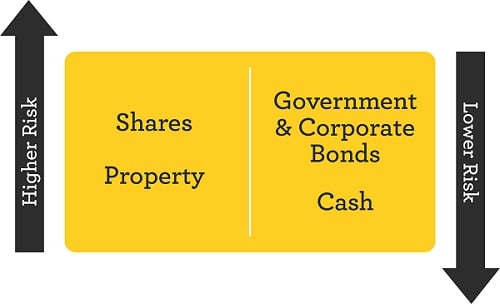
Consider how much investment risk you're prepared to accept. If you have a long-term plan, you may be willing to tolerate market fluctuations. Long-term planning allows you to potentially take on more risk as the impact of shorter-term fluctuations can be smaller. If your risk tolerance is low, consider a portfolio with a lower weighting towards shares.
If you are not sure about your risk appetite and where to invest, we recommend speaking to an NFU Mutual Financial Adviser.
Why Diversification Matters
Spreading your investments across a range of asset types - such as shares, bonds, property, and cash - can help manage risk. Including a mix of company sizes and geographic regions may also contribute to a more balanced portfolio. Different types of investments tend to respond differently to changing market conditions, so having a broad mix can help smooth out some of the ups and downs over time.
Seeking Financial Advice
During periods of market volatility, it can be beneficial to seek professional financial advice. Working together with your NFU Mutual Financial Adviser, you can build a portfolio that meets your needs and supports your financial goals.
The benefits of Active Fund Management
Investing into a managed fund offers the advantage of an investment manager having strategic oversight of how the fund is invested. Unlike passive index tracking, an active manager can tailor the fund allocation to a specific risk tolerance, and market conditions. They continuously monitor the fund to capitalise on opportunities and mitigate risks, ensuring your money is not overly exposed to any single sector.
Tax Considerations
Pensions and ISAs have the benefit of being tax efficient. Where the underlying investments grow, that growth is not subject to UK Income Tax or Capital Gains Tax.
Pensions
- With a personal pension plan for every £80 you invest the government will add £20. If you pay 40% or 45% income tax, you can reclaim additional tax relief directly from HMRC.
- At retirement, when accessing the pension benefits, 25% of the value is tax free*, and 75% is taxable at the owner’s income tax rate.
*Capped at £268,275 unless you have registered for protection. Speak to your NFU Mutual Financial Adviser for more information.
ISAs
- ISAs offer a tax-efficient environment for any income or capital growth to be free of UK Income Tax and Capital Gains Tax. You can access your money at any time.
- Stocks and shares ISAs currently have a contribution limit of £20,000 per tax year, this allowance can change.
The tax treatment of ISAs and pensions depends on individual circumstances and may change in the future.
You should be aware that the value of investments can rise or fall, and you may get back less than invested.
NFU Mutual Financial Advisers advise on NFU Mutual products and selected products from specialist providers. When you contact us, we'll explain the advice services we offer and the charges. Financial advice is provided by NFU Mutual Select Investments Ltd.

Looking for financial advice?
If you’re not sure how to put your financial plan in place, one of our NFU Mutual Financial Advisers can help. They'll be able to recommend products that are right for you based upon your personal circumstances. You can book an appointment with an NFU Mutual Financial Adviser by either calling: 0800 622 323 or requesting a call back.